Thank you for the nice compliment! I’ll try to answer your questions 🙂
I assume your current teacher is not the same person as the one back in 2024, right? Either your playing has increased a lot since then, or you did a step up with your current teacher, showing you a way that works better for you with some scores.
Yes, I’ve only been with my teacher since Fall 2025. My teacher in 2024 was pretty good, but in retrospect, he didn’t really have creative ideas to get me past “stuck points,” whereas my current teacher is full of them. I don’t think my playing has necessarily improved, but what has improved is how I look at more complex scores and “get inside them.” So to speak. This score was a reading challenge for me, and having worked it up, I notice that other scores now seem easier. One of the biggest things my current teacher did with this score was to force me to go in and write in a lot more fingering than I normally would. And to really make conscious decisions throughout about which hand to use for parts where either RH or LH would work. It’s an obvious thing, and something I’ve known for years, but playing things the same way every time, and playing same/similar passages with the same fingering is important in any piece, but for this piece, it was a make-or-break element to getting the piece into my fingers.
You talked about inner voices: I never heard this term before, but I think I have the same problem. The score I am learning now (and did not finish unitl this recital) has some notes written for the LH, but my RH seems to be just in the right place with my fingers already set to the right keys. So I decided to play some notes of the bottom staff with the right hand. Writing down the fingering was an issue: How can I convince my brain to play notes written for the LH with my RH instead? I did pencil arcs to somehow indicate this belongs to the top staff. Looked ugly. Then I rewrote the entire score with my PC and musescore, shifting notes from the bottom staff to the top staff... Probably a waste of time.
How did you write down your fingerings? Is there a notation trick, if the notes aren't on the staff you want them to have?
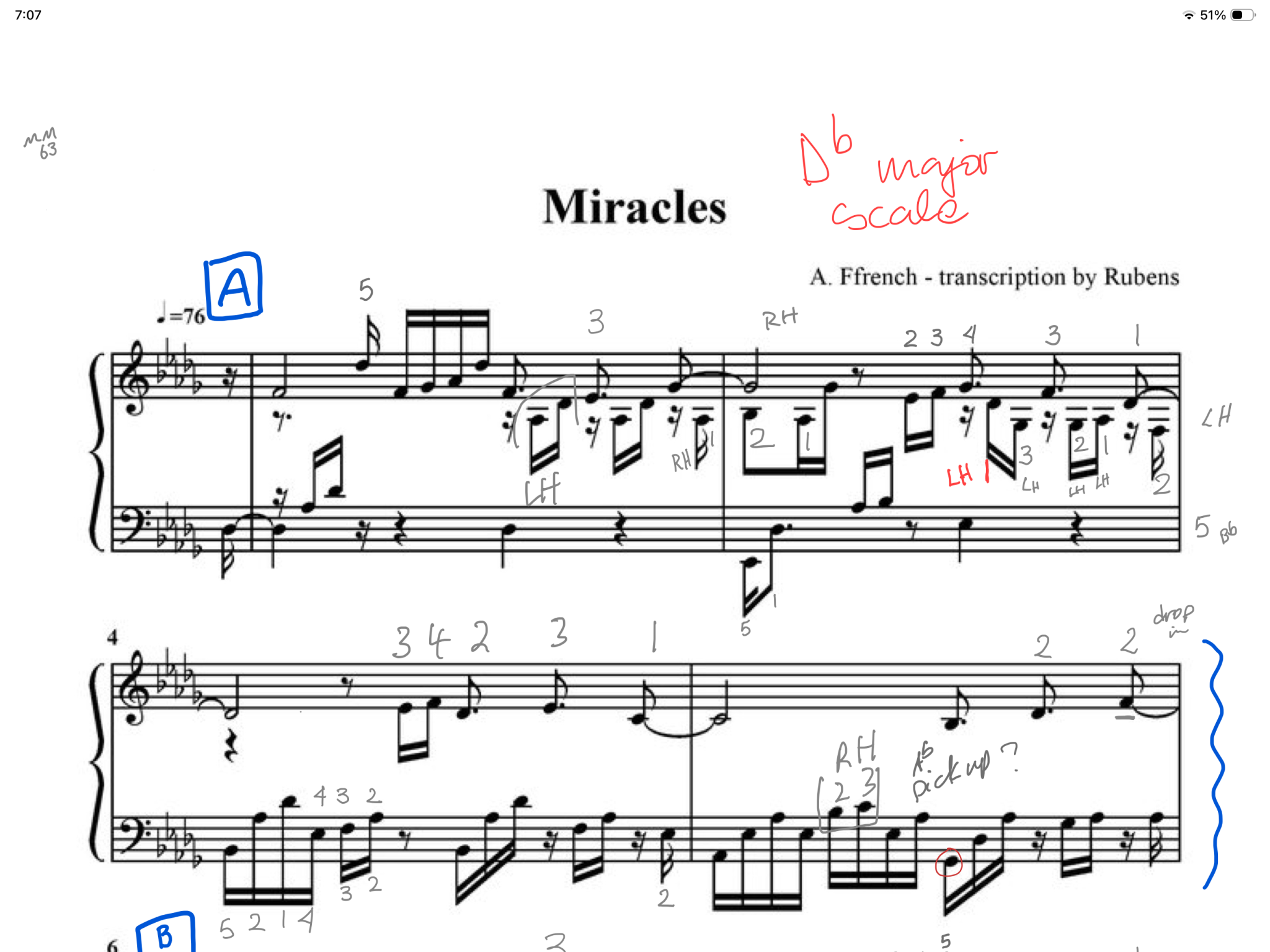
I would recommend not rewriting the score, for one thing, that could become a crutch. You’re definitely better off getting comfortable with the visual experience of using a complex score. I use a few different ways to notate, including just writing “LH,” drawing arcs, using brackets, and so on. It’s not pretty but I’m ok with that! Here are two examples:
And one more:
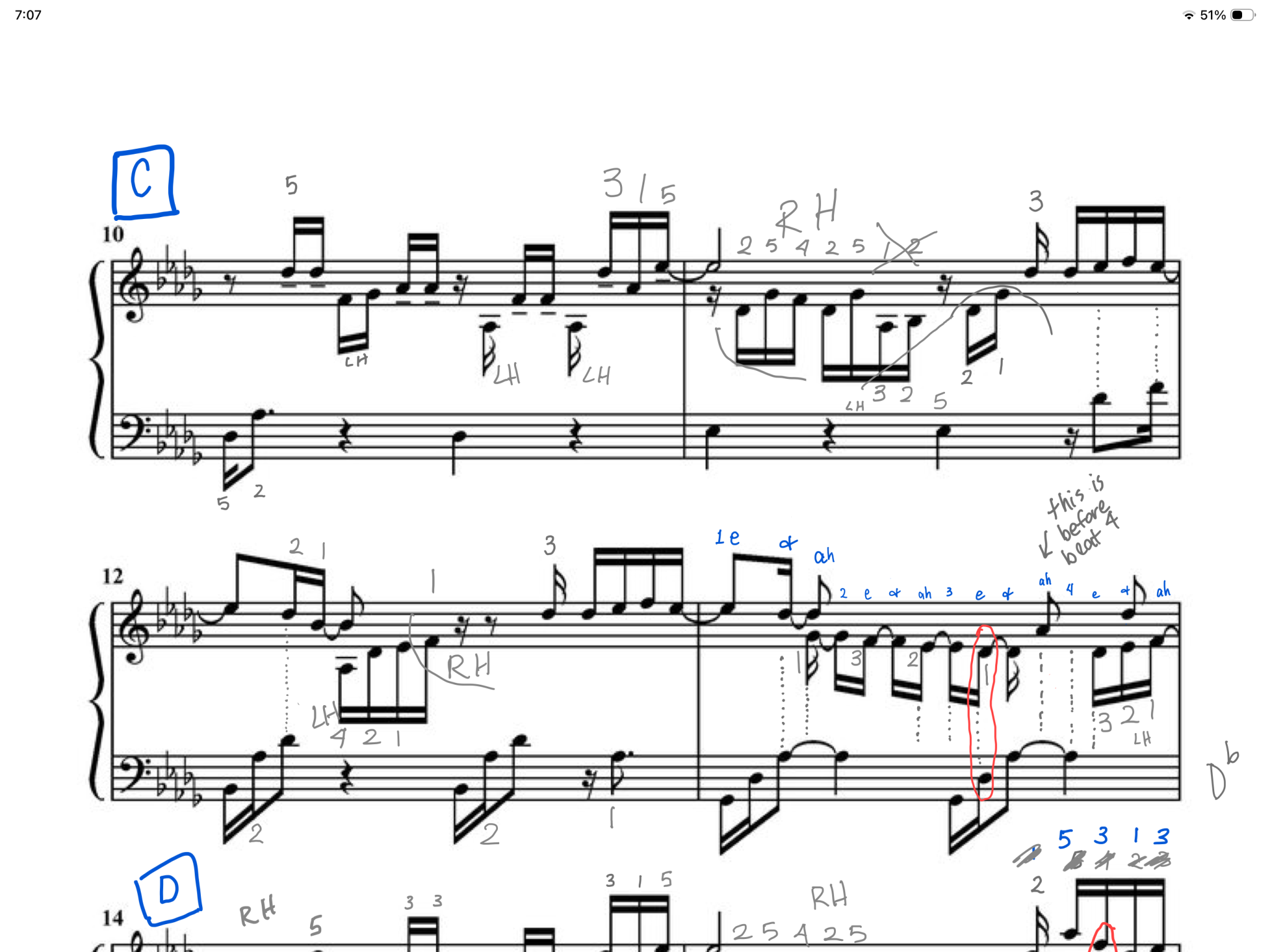
So just in these two snippets, you can see four methods I used to remind myself of where to play with a specific hand: 1) simply writing LH, 2) drawing an arc across a group of notes, with an up-facing arc meaning RH, and a down-facing arc meaning LH, 3) writing square brackets around a group of notes and writing LH, and 4) circling notes across the two clefs where it’s the same note.
You might also notice that I primarily use gray “ink” which I like because it looks like pencil markings. Then I can use red or blue for things I want to stand out. This is a benefit of using a digital score and changing pencils or pen colors is something I would never do when I used to use paper scores. Also, being able to erase on the digital score has become essential for me with more complex pieces because sometimes it takes a while before I settle on those fingering or hand decisions.
One thing: Is my memory faulty, but didn't you have the same score problem recently? Was it an Einaudi you can't buy. Or only with enormous shipping cost? Or do I mix you up with someone else here in the forum?
No, you’re remembering right, there was an Einaudi score collection that I wanted that is only available from an overseas store and the shipping was something like $30 over and above the price of the book itself. I have many of the pieces in the book and I just couldn’t justify $65 for the whole thing. I think I can buy the one piece, but I haven’t yet. Now that you’ve reminded me, I’ll do that today! 😃