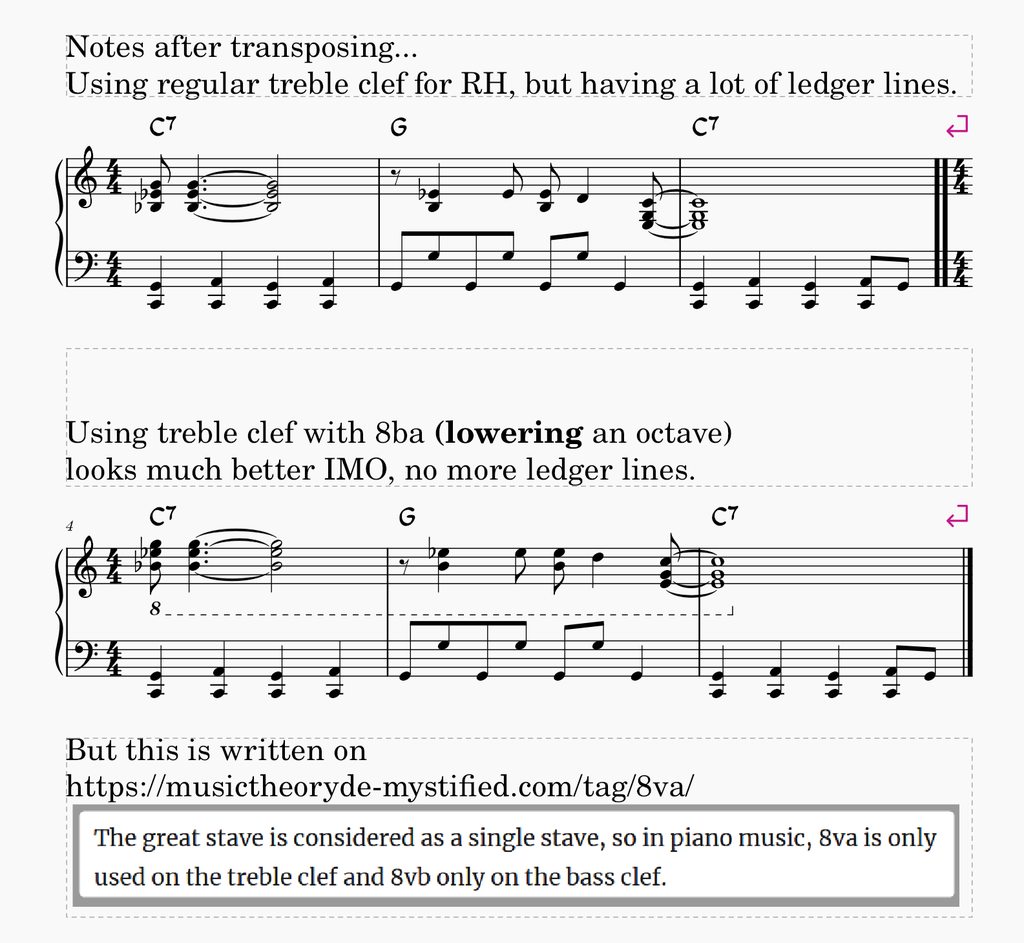
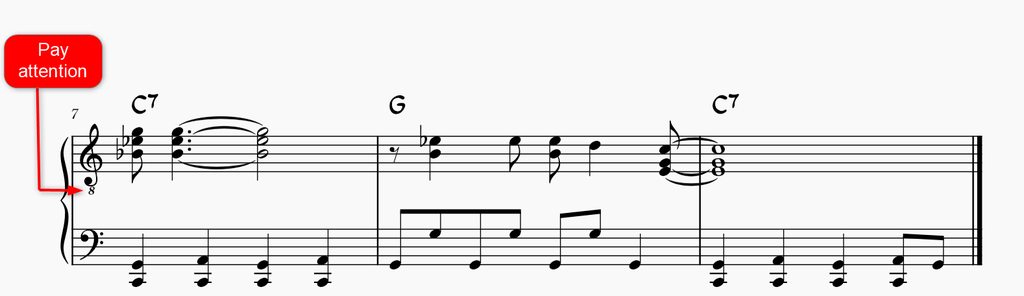
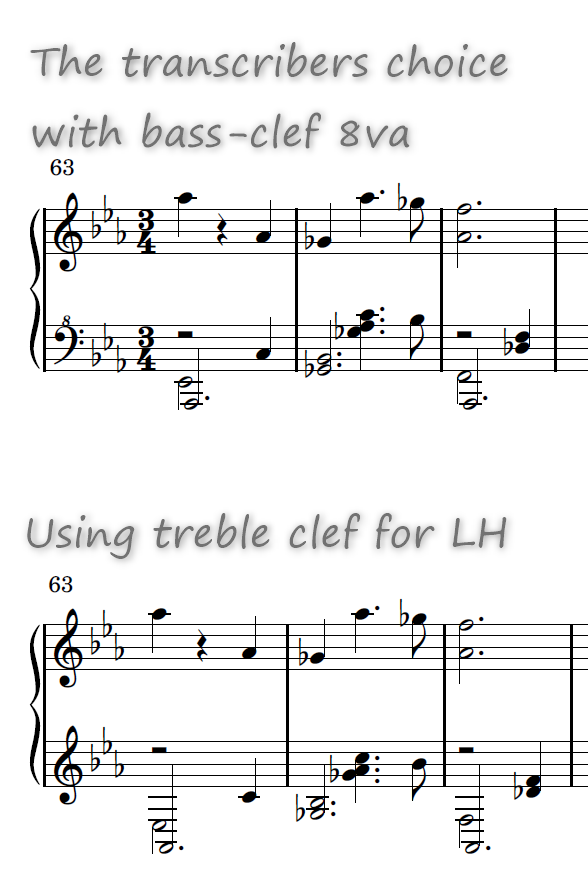
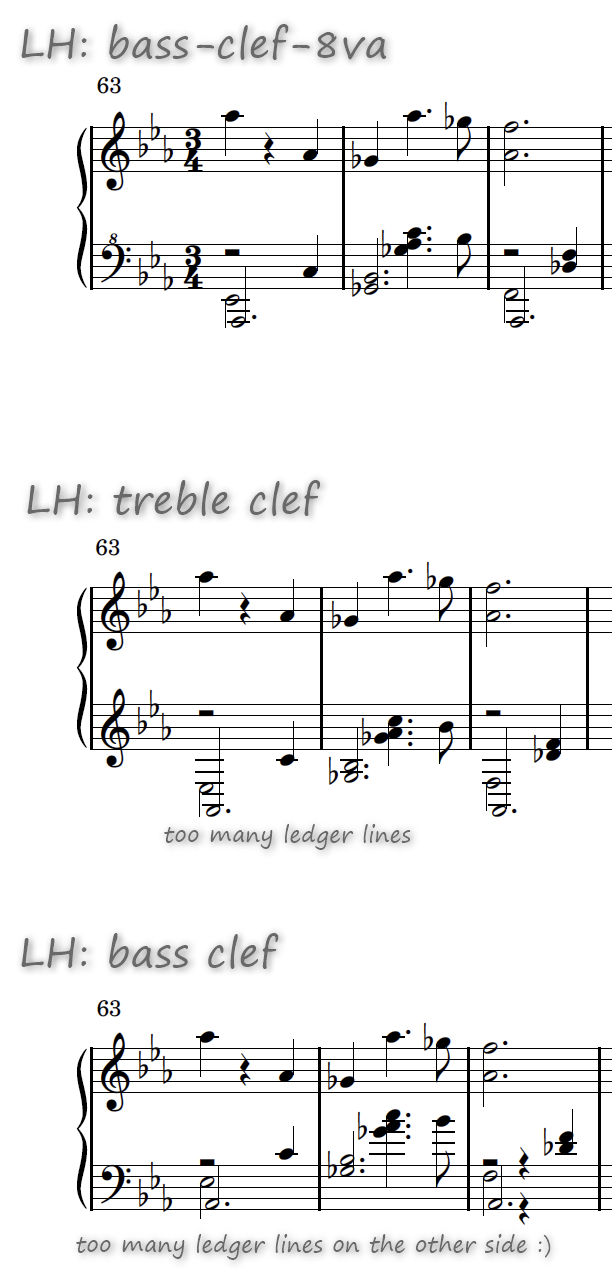
pianoloverus Thank you for this example. (This is the stuff I am looking for💕) The author was obviously in the same dilemma as me, just the other way round. And he used the more elegant and subtle way of indicating an octave shift. Actually, this is also something, that is not allowed according to some rules. But without that trick, there would be a lot of ledger lines to be read. And IMO it makes perfectly sense to use the notation in this way.
In another thread, at another forum Sam pointed out, he'd prefer the 8va---- notation over the tiny 8 above or below the clef sign because it is less likely to be overread. I think this is a valid point.
btw: I just wonder, why we don't run more often into this problem, when the notes are all located around middle C, plus minus 10 notes or so. Treble clef is too high, bass clef too low and "officially" none of them is allowed to be shifted towards the other clef.
I still think, our current way to write piano music is flawed, and it would be much easier to have only one single clef, but with indications for a number of different octaves. Especially, as there is a gap between base- and treble clef and without an own octave range between both, one must use one of both clefs with a lot of ledger lines. Or use this (invalid) trick with any 8va/ba notation in either way. (In my opinion just a proof, the current way for piano sheet music notation IS flawed). But we had this discussion already (before PASHKULI derailed it with a lot of nons...) ( WieWaldi ) .